

Many travellers told us that India is magical, but also overwhelming and crazy at times. Zooming rickshaws, traffic noise, heavy crowds and packed trains. Not sure we were ready for the intense, heady-side of India, we researched the south to find a “soft India” trip for our first foray into this beautiful and chaotic country.
We settled on Kerala.
This south Indian state known for being one of the cleanest and safest states, and with 100% literacy rates locals are proud of. We visited Kerala in November and spent two weeks exploring Kerala’s crumbling colonial cities, tranquil backwaters, verdant tea plantations and scorching beaches.
2 Week Travel Route in Kerala
- Fly into Kochi (COK), spend 1 night in Fort Kochi.
- On the way to Munnar from Kochi, spend a tranquil night relaxing at Windermere River House.
- Continue on to Munnar, spend 3 nights at the Windermere Estate to see the tea plantations.
- Spend 2 nights at the backwaters.
- Spend 5 nights relaxing on Varkala Beach.
- Fly out from Thiruvananthapuram International Airport (TRV) in the south.
Alternative Kerala Itinerary
We didn’t do this, but… you could swap Kumarakom for Munroe Island to get a less crowded/polluted version of the backwaters. You could also add Thekkady National Park before Varkala if you don’t want to have so many days at the beach.
Why Visit Kerala?
We spoke to locals, international travellers and local Indian travellers and all but one agreed: Kerala is the best part of India to visit.
This is because Kerala is your “soft landing” into India. If you’ve always wanted to explore India’s culture, cuisine, people and beautiful landscapes, but skip the pollution, hassle, traffic and general chaos, then “God’s own country” (as Kerala is locally known) is the place for you.
- The people of Kerala are kind and welcoming. It’s much less overcrowded than some other Indian states.
- The cuisine is delicious, very vegetarian-friendly, and cooking classes are highly educational.
- The landscapes are varied, including colonial cityscapes, gentle backwaters and rolling tea plantations.
Kochi
Beautifully dressed young Indian women pose for photos outside crumbling colonial buildings, fabrics, teas, ayurvedic oils and spices tumble out of overflowing stores, fishermen haul up giant Chinese nets, watched closely by tourists and seabirds alike. Kochi is Kerala’s main colonial city, and a glimpse into the state’s colonial and pre-colonial past.


Best Things To Do in Kochi
- Visit Jew Town and the Old Synagogue
Start your morning in Kochi with a stroll through Jew Town. Estimates vary, but even conservative guesses put the Jewish history in Kerala as starting almost 2,000 years ago.
Jew Town is an excellent place to buy gifts for family members back home. There’s a haggle system, but it’s less intense than in other places we’ve visited.
You can visit the synagogue, which is the oldest still working synagogue in the commonwealth, for only 10 rupees per person.
- Explore Mattancherry Palace (Dutch Palace)
Next to Jew Town, Mattancherry Palace has been converted to a small but fascinating museum. It costs only 5 rupees per person to enter and far exceeded our expectations given that price point. The star of the palace are the beautiful murals depicting scenes from the Hindu cosmos, like the Ramayana. Don’t miss this!
- Visit Lila – Curated Experiences
My one regret from Kochi is that I didn’t get a sweet treat from Lila – Curated Experiences. This is a beautiful colonial building (complete with a line of well-dressed Indian women taking Instagram shots outside) which houses a small cafe, art gallery, and a couple of shops. The sweets look decent, but the building itself is the reason to visit.
- Take photos of the Chinese Fishing Nets
We almost skipped the Chinese fishing nets, not eating fish ourselves, but I’m glad we took a chance. The huge counterweighted nets, manned by three fishermen at the end of a jetty, are an impressive sight up close.
We didn’t help lift the net, but stayed to watch the catch: just a few tiny fish. Within seconds a heron, a kite, and a pair of eagles swooped in, turning it into an incredible little spectacle. I only wish I’d been fast enough to get a photo. We tipped the fisherman 100 rupees for his time, which made his day.
Where To Eat in Kochi
We ate at Postcard Mandalay in Jew Town, which is a beautiful modern hotel in Mattancherry with a restaurant. We ate decent dosa and had a quick walk around the garden. We looked at staying at Postcard Mandalay, which is undoubtedly nice, but very much on the expensive side.
Best Places to Stay in Kochi
Tourists normally either stay in Mattancherry or Fort Kochi. Mattancherry is where Jew Town is located, whereas Fort Kochi is a slightly larger old town. I must admit, I didn’t realise that it was a 30-minute walk (and not a particularly nice one) between Mattancherry and Fort Kochi. We stayed in Mattancherry, at the clean and friendly Dutch Manor Hotel, but I think I’d look at staying in Fort Kochi next time.
Munnar
Munnar means one thing: rolling, verdant tea plantations draped over sweeping hills. It’s India best enjoyed at a slower pace, ideally with a steaming cup of cardamom tea in hand. The cooler, mistier climate is a welcome relief from the coastal heat, and the blue-sky mornings are breathtaking.

Best Things To Do in Munnar
- Hike the Seven Hills of the Lakshmi Estate
If you do only one thing in Munnar, make it the Seven Hills hike on the Lakshmi Estate (3-5 hours). It’s the best way to experience functional tea plantations up close. While you could technically navigate it alone, I found having a guide helpful — some paths cross private property and it’s not always obvious where access is permitted. Arrange a guide through your accommodation, and do it a day or two before you plan to hike.


- Go Birdwatching in Munnar
Munnar — and the Western Ghats more broadly — is renowned for excellent birdwatching. Our favourite sighting was the sunbird, Asia’s answer to the hummingbird. It drinks nectar, hops rather than hovers, and has the same delicate beak and build.
My second favourite sighting (birdwatchers, forgive me) was the giant Malabar squirrel. This charming, monkey-sized climber is endemic to the region. Our birdwatching tour was arranged as part of our stay at Windermere Estate.


This is a significant peak in the region, offering spectacular views of the surrounding tea fields… when the weather cooperates. It didn’t for us. We paid the 800-rupees entry fee moments before a wall of fog rolled in. Because we hadn’t booked in advance, we didn’t have a guide, and ended up abandoning the hike as parts of it felt genuinely precarious in those conditions.
- Visit the Lockhart Tea Factory
If you want to see how tea is processed, Lockhart Tea Factory is the place to go. Entry is 250 rupees and tours depart every 30 minutes. Note that this isn’t the spot for walking through plantations themselves, and we couldn’t buy a cup of tea either as the café was closed for maintenance.
Best Place to Stay in Munnar
It’s important to realise that “Munnar” refers to both the town and the wider region. Munnar town itself isn’t where we’d recommend staying: it’s crowded, busy, and noisy. The best experience comes from staying in the surrounding hills.
Windermere Estate
Look for accommodation that provides meals and can help arrange transport. We highly recommend the beautiful Windermere Estate, a working cardamom farm run by an exceptionally friendly and welcoming team. They made our stay genuinely special.


Blackberry Hills
We also visited Blackberry Hills for a meal and thought it looked like another excellent option. The restaurant’s view was extraordinary, and they offer yoga and Ayurvedic treatments at their spa.
Stopover: Windermere River House (2-hours from Munnar)
Windermere River House sits midway between Munnar and Alleppey, tucked along an idyllic riverbank surrounded by tropical flowers, fluttering butterflies, and free-roaming peacocks. It’s a peaceful retreat from the wider world, a place to read, do yoga, and reconnect with nature. Though we didn’t stay at the River House, we were invited to visit and break up a long journey by the charming Dr John Simon who made an excellent impression on us.


Kerala Backwaters (Alleppey / Kumarakom)
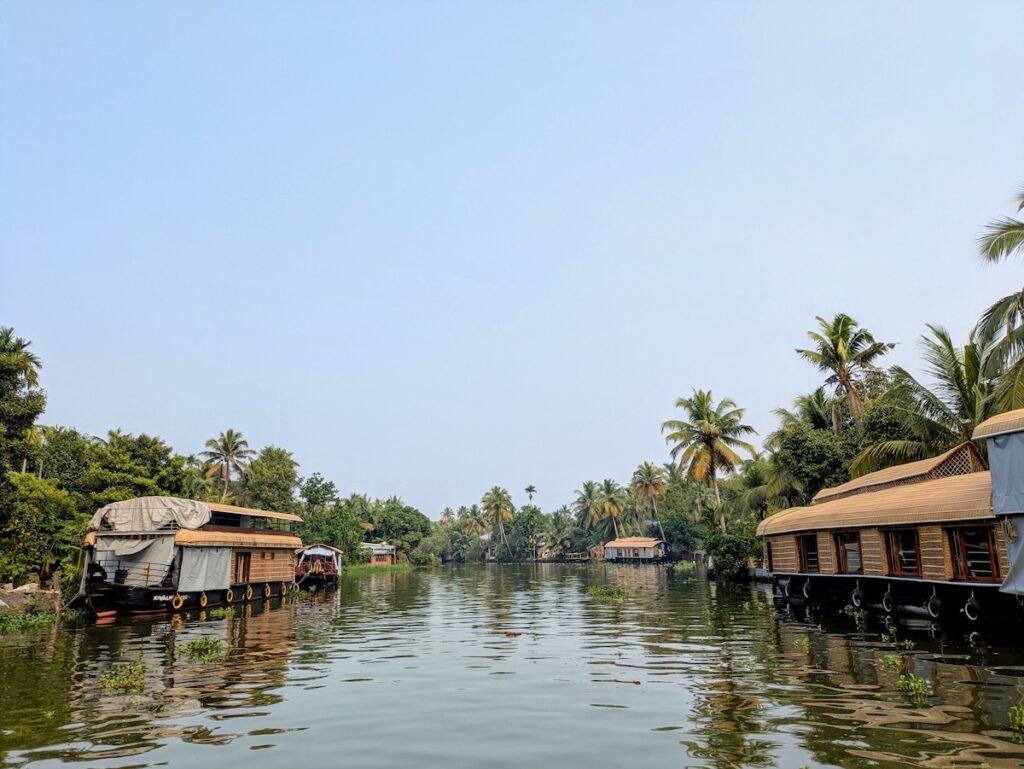
The backwaters: an endless maze of waterways, coconut trees, rice paddies and fuchsia pink water lilies. Read on to find out we decided to take a motorised canoe, rather than a traditional houseboat, and stay in Kumarakom, rather than the better known Alleppey (Alappuzha).

Best Things To Do in the Kerala Backwaters
- Take a canoe through the Backwaters
Our sunrise trip on a motorised canoe (4,500 rupees) began at 6:00 a.m., right from the doorstep of Little Chembaka homestay.
At that hour the backwaters were glassy and quiet, and only the birds witnessed our slow progress along the narrow channels. Gradually, the villages around us stirred to life. We stopped at a local tea shop—friendly, though very male-dominated, almost like stepping into a British pub in the 1980s — and later watched how rope is made from coconut fibre and how palm wine is tapped from the coconut tree.
Some stretches showed more plastic than wildlife; others were utterly serene, with the November sun warming the water and birds everywhere you looked. Though the backwaters are less fashionable with tourists than they once were, we loved the trip and would strongly recommend exploring them by canoe rather than by houseboat.
Sadly, the houseboat industry itself is in visible decline. A local explained that a boom in demand led to overcrowded waterways and a race to the bottom on prices. Standards fell, visitor experiences suffered, and the decline accelerated. We saw more than a hundred houseboats tied up, but only two or three actually out on the water—and even those carried just a handful of guests.


- Take a cooking class in Kumarakom
Learn the essentials of Keralan cooking, from how coconut oil is made to the inner workings of a real spice factory. We arranged our class through Little Chembaka, and I loaded up my phone with 10+ authentic recipes that I can’t wait to try back home.
Jes, our energetic instructor, patiently walked us through the foundations of Keralan cuisine late into the evening, then followed up the next morning with extra notes and tips. The class is on the pricier side by local standards, but if you’re interested in Indian cooking, it’s absolutely worth it.
Best Place to Stay in the Backwaters
We chose to stay in Kumarakom rather than Alleppey (officially Alappuzha) after some research, and we’re glad we did. Alleppey felt far more touristy, while Kumarakom offered the peace and quiet we were hoping for.
Our base was Little Chembaka Homestay, essentially a private cabin overlooking the river. The stay was fantastic, thanks largely to Jes, our host, who spent hours talking about Kerala, India, and life in general. The only downside is its proximity to a road, but the overall experience more than made up for it.


Varkala Beach
Varkala is a coastal town in southern Kerala, known for its surf breaks, yoga culture, and a ribbon of restaurants and shops perched dramatically along the cliffside. I’ll be honest: our first impression wasn’t great. The combination of unseasonable rain and weekend crowds left the place feeling chaotic and a little overwhelming. But once the weekend rush ebbed and the sun finally appeared, Varkala shifted into a slower, more tranquil rhythm than we came to enjoy immensely.

Best Things To Do in Varkala
Yoga surely has to rank among India’s greatest cultural exports. Our 90-minute yoga class, provided by Utopia Varkala, was great, with a focus on wisdom, spirituality and inner peace.
Varkala is a great place for beginner to intermediate surfing. Whilst it lacks the clean pipes of Bali, the waves are consistently powerful enough that you’ll have plenty of chances to learn how to stand. Varkala does have riptides, so join a surf school to be safe (1,500 rupees). We booked lessons through Moon Waves Surf and our friendly instructor, Rohith, helped us both improve massively.
Note that at the time of writing, the best surfing beach (Edava Beach) was closed due to disputes between surfers and local fishermen. We still had a blast on the beginner waves elsewhere, but check beach closures before you visit.
- Enjoy an Ayurvedic massage
Enjoy an oily Ayurvedic massage to relax your muscles after an early morning surf or yoga session. We visited the excellent and distinctly high-end Gramam Living for a 30-minute couples massage that cost 1,800 rupees each.
Best Places to Eat in Varkala
Idli, which like dosa, is made from a fermented rice-and-lentil batter, comes in an astonishing range of shapes and sizes across Kerala. Tickety Boo serves some of the most authentic, no-frills idlis around. You eat with your hands: tear off a piece, dip it into sambar or chutney, and let the flavours do the rest. Prices are wonderfully old-school too. Mains start at just 80 rupees (under £1), and a cup of chai is 10 rupees (about 8.5p). The staff are deaf, but ordering is effortless; gestures and smiles seem to be a universal language here.
- Enjoy the views from Café Sarwaa
Perched near South Cliff, Café Sarwaa is a Varkala institution — something the ever-present queue makes very clear. It’s absolutely worth the wait for both the views and the food. I especially loved the momos.
Vedaa by Aum in Odayam was by far our favourite coffee and food stop. The coconut iced latte is particularly good. Their food is freshly prepared and we enjoyed it all. Try the uttapam and paratha plate.
Best Places to Stay in Varkala
Most travellers base themselves in one of three areas: North Cliff, South Cliff or Odayam. North Cliff is the most developed and lively, and best avoided if you’re not into neon lights and booming music.
Soul & Surf Kerala
South Cliff, by contrast, is close to Varkala Town yet feels far more peaceful. I’d recommend Soul & Surf Kerala, which has a lovely clifftop garden along with daily surf lessons and yoga classes. Yoga is offered in the evenings here, a real bonus, since the best waves are usually in the morning. The accommodation is, however, overpriced for the area. We only ate here in their garden, but didn’t stay.

Utopia Varkala
Even quieter is Odayam. We stayed at Utopia Varkala, which overlooks green rice paddies and offers rooftop yoga three or four times a week. It’s run by a Czech mother and daughter who have lived in India for many years, and has a relaxed and laid-back feel. We fell in love with the rice paddy views.


Have you always wanted to visit India, but been put off by some of the chaos stories?
Let us know in the comments below!